siteverNEW

Split Angles

Split angles are here to stay! With the introduction of our 28 degree baseplate, you are able to create a proper split angle setup with the Sabre system, with a 20 degree difference betwen your front and rear trucks.

But what is a split angle longbard setup and why would you want to do it? All is explained below…

What does a split angle truck setup do?

The goal of a split angle truck setup is to make a board turn more at the front than it does at the back.

A split angle truck setup combines a steeper geometry front truck (eg a Sabre 48 degree) with a shallower geometry for the rear truck (eg a Sabre 28 degree).

It’s common practice to use a softer bushing setup on the front truck, and a harder bushing setup on the back truck.

Split angles have been common practice in the Slalom, downhill and long distance pumping (LDP) worlds for many years. Split Angle boards:

  •  Are easier to pump (propel your board without pushing)
  •  Lean more into carves, closer to the board movement of a Surfboard or Snowboard
  •  Are more stable at high speeds
  •  Are more agile at slow speeds

Here at Sabre, we believe that it’s time that more casual users embraced split angles too, as boards like this offer huge benefits that skaters of all abilities can enjoy. We’re on a mission to bring Split Angles to everyone!

  • Image
    A split angle setup uses different truck angles at either end of the board - steeper at the front, slacker at the rear.

How does a split angle setup work?

At first, a Split Angle truck set feels like magic… how can a setup add stability AND be more agile?

The trick is to think about the two trucks moving differently as the skater (you) leans the board over in a turn.

At a given deck lean angle, the front truck and the rear truck will be on different turning radii as the board tracks an arc through the turn.

This differential in turning circles means that the trucks have a preponderance to snap back to the center – and make the board travel in a straight line. As you start to lean over more, the difference in turning radius between the two trucks becomes greater, and the return to center becomes stronger.

All this makes a split angle setup inherently stable.

We have to be careful illustrating this, as this is obviously not quite what happens… board lean and turn is a lot more dynamic and chaotic than this picture shows!

But what does all this feel like?

You can feel the differential between the back and front truck in two ways as you skate along.

  1. Firstly, you’ll notice that your board turns more from the front. This rewards a more engaged skating style – as you move your weight forward on the board, you’ll turn more, and as you lean back, you’ll turn less.
  2. Second, you’ll notice that the board wants to “return to center” – or “return to going in a straight line” – more than it would with regular trucks.

This stronger return to center is a key part of what makes split angle work so well.
It calms down speed wobbles before they develop, by acting like a “rudder” or “tailfin”.
It makes pumping easier, as the trucks are effectively helping you shift your weight more rapidly from one rail to another.

It makes the board slide differently, in a good way, for downhill. A split angle setup is much easier to bring back intro grip once you have started sliding, which makes Speed Checks (short slides for braking into a corner) easier. You will have to adjust your technique though, especially for standup slides.

For advocates of board feel, a split angle setup will often feel “snappier” whilst carving. The board pushes back on the rider input, helping to spring the skater out of deep turns. This gives confidence to turn harder, as the perception is that the board will recover from a deeper, leaning turn more easily.

  • Image
    With a regular symmetrical setup, both trucks behave the same at a given deck lean angle.
  • Image
    With a split angle setup, the difference lean/turn ratio between the front and back truck makes the board snap back to a straight line.

How do split angle setups affect my bushing choice?

A key part of a split angle setup is the bushing choice. Let’s look at the front truck first.

Bushings: Front Truck

Generally, you want to set up your front truck to turn as much as possible, without getting wheelbite.

It needs to almost “collapse” into the turn, with no resistance at all.

We recommend running the softest possible bushing in a cone shape with a decent cup washer. This will give loads of turn, minimise wheelbite, and enough rebound to get the board back under you. Go as soft and loose as you dare!

Bushings: Rear Truck

As the rear truck is a much slacker angle, the axle path is almost straight up into the deck. Avoiding wheelbite therefore requires a harder bushing durometer, and a more supportive shape.

A more supported back truck creates a stable platform from which to drive the board forwards.

We recommend a barrel/cone or even barrel/barrel combination for the rear, at least five duro stops harder than the front. More aggressive skaters, or those skating at higher speeds, would probably want to go 10 duro stops or more up front the front truck.

  • Image
    Softer bushings on the front, harder bushings on the back.

Bushings: Rider weight, durometer and speed

With symmetrical truck setups, heavier riders and higher speeds require harder bushings.

Things are not quite so simple with split angle trucks.

First – rider weight.

On a symmetrical setup, lighter riders often need to change to softer bushings to make the board more reactive.

Conversely, heavier riders, need to change to harder bushings to avoid wheelbite and calm the board down to avoid wobble.

Split angle setups change this, as you board is suddenly more stable, and more agile, at the same time.

This means that lighter riders don’t need to worry about the board not turning enough, and heavier riders don’t need to work about wobbles quite so much.
The main reasons to change bushing durometer in a split angle setup are to avoid wheelbite, and change how your board turns.

Next up – wheelbite.

Generally you need the board to be as loose as possible without the wheels ever touching the deck. The more active your board is under you, the more you’ll feel the benefits of split angle trucks.

We recommend that you get as close to wheelbite as you can!

Most important – ride feel and durometer difference

Ride feel is a little more subjective. A bigger durometer difference between the front and rear trucks will change how the board turns, slides and pumps.

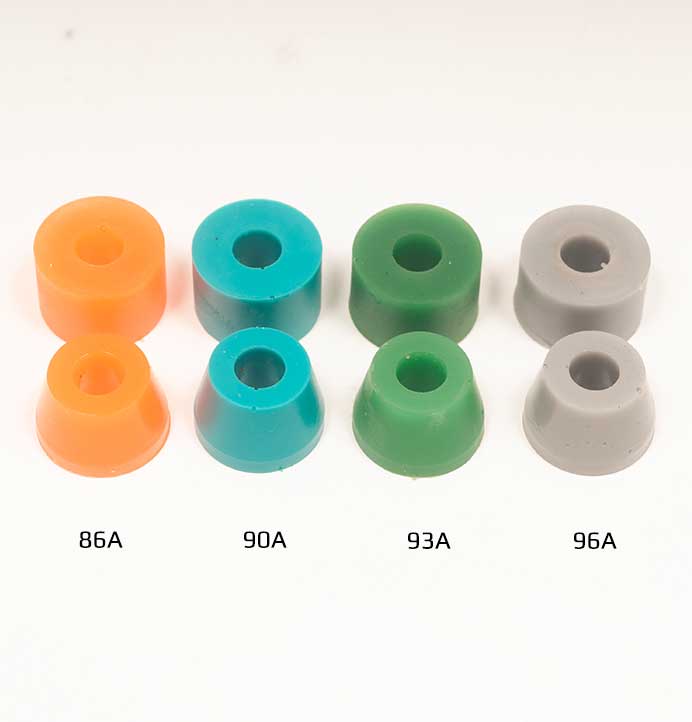
A bigger durometer difference – imagine 86A front, 96a back – will have a stronger “return to center” feeling, outlined above. Your board will feel snappier back into grip, it’ll be more stable, and you might find it easier to pump at higher speeds. A bigger split suits high speeds and a more aggressive style.

A smaller durometer difference – perhaps 86A front, 93A back – will be more active under the skater, and feel more agile at slower speeds. It might be easier to pump initially, but once you’re up to speed you might find it harder to maintain.

To some extent, the benefits that split angles bring over symmetrical setups are lessened with a smaller durometer difference – although the truck geometry alone does a lot of the work, so going to a smaller difference only does so much.

We ship our spilt angle truck sets with 93A and 96A bushings for your rear truck, so you can experiment and work out what you prefer. We recommend the 96A for most skaters with the forged hanger, and 93A with the cast hanger, but it’s worth changing it up if you feel like the board isn’t lively enough.

  • Image
    Use a combination of durometers and shapes to dial in your ride.

Get social